
Mostrar mensagens com a etiqueta Americas Cup. Mostrar todas as mensagens
Mostrar mensagens com a etiqueta Americas Cup. Mostrar todas as mensagens
quinta-feira, 7 de fevereiro de 2013


quarta-feira, 6 de fevereiro de 2013
sexta-feira, 1 de fevereiro de 2013
terça-feira, 8 de janeiro de 2013
Taking the big cat apart piece by piece
Fonte: America's Cup
The Emirates Team New Zealand AC72 has been reduced to its component pieces, a delicate operation which took the best part of two weeks to accomplish. Winch drums and some hardware has been removed to be installed on Boat 2 which will be delivered to the team’s Auckland Viaduct Harbour base early in January.
Shore crew members have worked long and hard to complete decommissioning before Christmas. From tomorrow they will have a little time off before setting about the task of commissioning Boat 2 for its launch in early February.
Chris Cameron’s pictures are here.
The Emirates Team New Zealand AC72 has been reduced to its component pieces, a delicate operation which took the best part of two weeks to accomplish. Winch drums and some hardware has been removed to be installed on Boat 2 which will be delivered to the team’s Auckland Viaduct Harbour base early in January.
Shore crew members have worked long and hard to complete decommissioning before Christmas. From tomorrow they will have a little time off before setting about the task of commissioning Boat 2 for its launch in early February.
Chris Cameron’s pictures are here.
A sailor’s life is not an easy one
Fonte: America's Cup
As you all relax for the holidays, spare a thought for the Emirates Team New Zealand sailors who will be training hard every day to keep in shape for getting back out on to the water early in the new year. Here’s an update on the gym training programme from David Slyfield.
Luna Rossa skipper Max Sirena – Update from Auckland – “I think there is a chance to see more capsizes”

© Nigel Marpel / Luna Rossa Challenge
Fonte: AC34
Just before his team stopped sailing for a short break over the Christmas holidays in December, Luna Rossa Challenge skipper Max Sirena sat down at the team base on Auckland’s waterfront to answer some questions from americascup.com. Here are the highlights.
quinta-feira, 20 de dezembro de 2012
Reparação do AC72 quase concluída
Fonte: Oracle


View Photo
With a little more than a week remaining in the year, the focus for ORACLE TEAM USA hasn’t changed. All eyes have been on 2013 for months, for years, with the same goal in mind: defending the America’s Cup in San Francisco next September.
Ask any member of the team their New Year’s resolution and it likely involves winning the Cup. Or more immediately, it’s sailing ORACLE TEAM USA 17 again.
“The capsize has definitely been a setback,” said ORACLE TEAM USA general manager Grant Simmer. “We have lost a lot of sailing time and a lot of time for the team to figure out the new boat, which will be difficult to recover. We’re a sailing team, and it’s not great to be watching your competitors sailing when we’re unable to – that’s been tough. But, all of the team has really focused on fixing the issues, fixing the boat and getting back on the water as soon as possible.”
When the team’s AC72 pitch-poled in San Francisco Bay on October 16, the schedule changed. The wing was in pieces, the pod beat up, the hulls damaged from both water and as a result of the wing breaking apart.
Instead of waiting until the end of the year to reflect, the team found itself evaluating the program a couple months early.
“We’ve used the time to really reassess the entire program, to be more realistic about our planning, to be careful not to try to do too much, but to do everything that’s important and critical to development,” Simmer said. “We’ve become more mindful of the risks.”
The boat was dismantled – beams disconnected, systems removed – and the broken wing stripped down to salvageable pieces.
Work began immediately, and two major boat build projects were soon underway at the team base at Pier 80. Repairs of boat 1 began side-by-side with the build of boat 2.
“We’re very grateful for all of the guys here who have had to dig deep to make this all happen,” said Mark Turner, ORACLE TEAM USA shore team manager. “The repairs of boat 1 certainly haven’t been the easiest of tasks to accomplish, and the list wasn’t small. That’s all been going on in parallel to building boat 2. So, there’s been a lot going on here, just as there’s been a lot going on in New Zealand with getting wing 2 built. Both places – here and in New Zealand at Core Builders Composites – have been going along at a good clip.
“The entire shore crew has pitched in and done things they’re not really accustomed to doing, whether it’s helping with the repairs on boat 1, composite work, putting together flaps for wing 2, or helping out with boat 2’s assembly process,” Turner said.
The second AC72 wing was already under construction, so timeline on completion was adjusted. That wing is scheduled to arrive to San Francisco early in the new year.
“After the capsize, the first step was assessing the extent of damage,” Simmer said. “Clearly we had almost totally lost the wing. Luckily we had another wing in production at that time, and so we accelerated that process. With the platform we found there was quite a lot of water ingress in the hulls and the areas where the boat had suffered damage. So, we’ve repaired all of that, and the platform is currently going back together.”
Composite repair work has been completed and beams reattached. As the team heads into a much-needed holiday break, the work list on boat 1 will be whittled down.
At the start of the year, “it’s all going to happen pretty quickly,” Turner said, with hydraulic systems, wench systems, nets and more going back in place. The new wing will arrive and testing will commence.
At the same time, boat 2 construction remains full steam ahead.
While the schedule may have changed, and plans adjusted, all have remained clearly focused on 2013. All are anxious to get the first AC72 back on the water. And, all have the same goal in the new year – to win.
“The team has really had to stand up to take on the extra work on getting the boat fixed, and they’ve responded fantastically,” Simmer said. “You end up with more resolve at the end of a process like this. That’s true for this team, and I think we will be stronger because of it.
“We’ll be out sailing again at the beginning of February in our repaired and modified boat. We’re looking forward to a long list of testing and development that will ultimately lead us to the Cup. It’s going to be a busy and exciting year for all of us.”
View Photo
With a little more than a week remaining in the year, the focus for ORACLE TEAM USA hasn’t changed. All eyes have been on 2013 for months, for years, with the same goal in mind: defending the America’s Cup in San Francisco next September.
Ask any member of the team their New Year’s resolution and it likely involves winning the Cup. Or more immediately, it’s sailing ORACLE TEAM USA 17 again.
“The capsize has definitely been a setback,” said ORACLE TEAM USA general manager Grant Simmer. “We have lost a lot of sailing time and a lot of time for the team to figure out the new boat, which will be difficult to recover. We’re a sailing team, and it’s not great to be watching your competitors sailing when we’re unable to – that’s been tough. But, all of the team has really focused on fixing the issues, fixing the boat and getting back on the water as soon as possible.”
When the team’s AC72 pitch-poled in San Francisco Bay on October 16, the schedule changed. The wing was in pieces, the pod beat up, the hulls damaged from both water and as a result of the wing breaking apart.
Instead of waiting until the end of the year to reflect, the team found itself evaluating the program a couple months early.
“We’ve used the time to really reassess the entire program, to be more realistic about our planning, to be careful not to try to do too much, but to do everything that’s important and critical to development,” Simmer said. “We’ve become more mindful of the risks.”
The boat was dismantled – beams disconnected, systems removed – and the broken wing stripped down to salvageable pieces.
Work began immediately, and two major boat build projects were soon underway at the team base at Pier 80. Repairs of boat 1 began side-by-side with the build of boat 2.
“We’re very grateful for all of the guys here who have had to dig deep to make this all happen,” said Mark Turner, ORACLE TEAM USA shore team manager. “The repairs of boat 1 certainly haven’t been the easiest of tasks to accomplish, and the list wasn’t small. That’s all been going on in parallel to building boat 2. So, there’s been a lot going on here, just as there’s been a lot going on in New Zealand with getting wing 2 built. Both places – here and in New Zealand at Core Builders Composites – have been going along at a good clip.
“The entire shore crew has pitched in and done things they’re not really accustomed to doing, whether it’s helping with the repairs on boat 1, composite work, putting together flaps for wing 2, or helping out with boat 2’s assembly process,” Turner said.
The second AC72 wing was already under construction, so timeline on completion was adjusted. That wing is scheduled to arrive to San Francisco early in the new year.
“After the capsize, the first step was assessing the extent of damage,” Simmer said. “Clearly we had almost totally lost the wing. Luckily we had another wing in production at that time, and so we accelerated that process. With the platform we found there was quite a lot of water ingress in the hulls and the areas where the boat had suffered damage. So, we’ve repaired all of that, and the platform is currently going back together.”
Composite repair work has been completed and beams reattached. As the team heads into a much-needed holiday break, the work list on boat 1 will be whittled down.
At the start of the year, “it’s all going to happen pretty quickly,” Turner said, with hydraulic systems, wench systems, nets and more going back in place. The new wing will arrive and testing will commence.
At the same time, boat 2 construction remains full steam ahead.
While the schedule may have changed, and plans adjusted, all have remained clearly focused on 2013. All are anxious to get the first AC72 back on the water. And, all have the same goal in the new year – to win.
“The team has really had to stand up to take on the extra work on getting the boat fixed, and they’ve responded fantastically,” Simmer said. “You end up with more resolve at the end of a process like this. That’s true for this team, and I think we will be stronger because of it.
“We’ll be out sailing again at the beginning of February in our repaired and modified boat. We’re looking forward to a long list of testing and development that will ultimately lead us to the Cup. It’s going to be a busy and exciting year for all of us.”
quinta-feira, 22 de novembro de 2012
America's Cup boat's capsizing sparks questions, fears
Fonte: mercurynews.com

1 of 10
Oracle Team USA capsizes boat
In this photo taken Tuesday Oct. 16, 2012 and provided by Oracle Team USA, crew members hang from the mesh netting after the Oracle Team USA AC72 boat capsized on San Francisco Bay in San Francisco. The America's Cup champion syndicate is assessing the damage to its 72-foot (22-meter) catamaran, after it capsized and was swept by a strong current more than four miles (six kilometers) past the Golden Gate Bridge before rescue boats could control it.(AP Photo/Oracle Team USA, Guilain Grenier)
SAN FRANCISCO -- When Larry Ellison's new 72-foot America's Cup boat capsized on a practice run and was sucked through the Golden Gate in a crippled mess, the second-guessing and doubts among the sailing community began: Has Ellison's plan to turn the world's most famous yacht race into a high-tech white-knuckle NASCAR of the sea gone too far for speed?
"Everyone wants the fastest boat," said Richard Spindler, founder and publisher of Latitude 38, a sailing magazine based in Mill Valley. "But you can't win the race unless you finish."
Now, a month after Oracle Racing's new, custom-made USA 17 cartwheeled into San Francisco Bay, hurled its hotshot crew into the cold waters and crumpled the main sail structure, Ellison's pride is on the line as the sailing syndicate races against the clock to perform repairs and be ready to compete by September's America's Cup finals.
After winning the last Cup, Ellison was allowed to dictate the size and basic design of the boats for all the entries in this year's race. But some doubters are wondering whether the towering catamarans are too unwieldy and expensive and should follow the lead of Howard Hughes' giant flying boat, the "Spruce Goose" -- which was shelved for good after one flight.
Even America's Cup officials are talking about downsizing the catamaran for future races. But there's no time to turn back for this race.
"It's definitely a setback," Oracle Team USA skipper Jimmy Spithill
Advertisement
said of the newly built boat's capsize Oct. 16. He was at the helm and blames his risky maneuvers in especially rough conditions, not the boat design, for the catastrophe. "But it's not one that will stop us from winning the Cup," he said.
The boat's wreck on only its eighth practice run has focused scrutiny on the fundamental design of the so-called AC72 -- a new class of America's Cup boat built for excitement and speed. All three challengers have launched their customized versions, and at least one competitor is already complaining that the rigid wing serving as a mast and sail is too big.
If Ellison's team loses, the event he won in Spain in 2010 and brought for the first time to San Francisco -- promising millions of dollars in economic development and a thrilling spectator experience -- would move to the winning boat's home port.
Stephen Barclay, CEO of the America's Cup Event Authority, said the 72-footers are not too dangerous for the bay, but they are being reconsidered for future races because they are so expensive and big, requiring upward of 30 people to get them in and out of the water by crane. Only three teams, New Zealand, Sweden and Italy, could afford to challenge Oracle for the trophy next

he Oracle Team USA AC72 catamaran is capsized Oct. 16, 2012, on San Francisco Bay. (Guilain Grenier/Oracle Team USA)summer, compared with roughly a dozen challengers in past years.
Still, the capsize exposed the fundamental dilemma of the America's Cup: How extreme can a boat design be when it is racing in the bay's already extreme conditions with the most competitive sailors on the planet intent on going as fast as possible?
Along with wearing crash helmets and sharp knives strapped to body suits, Spithill's crew will now tuck into their chest pockets mini oxygen canisters. If sailors end up trapped underwater, they'll have 10 to 15 breaths to cut their way out from beneath the netted trampoline that spans the twin hulls.
"We have to plan for the worst," Spithill said. Still, "I think the boat has to be a challenge. It needs to have all the horsepower and risk. If you can only race to the top of first gear, it's boring. You need to be pushed."
He was pushing the limits a month ago in 30-knot winds clashing with the strongest ebb tide of the year. No one was injured when the boat pitch-poled end over end. But the rigid wing became a battering ram on the helpless hulls as it was flushed through the rough waters of the Golden Gate and then collapsed. Pieces of the wing are still washing up at beaches.
Spithill received a call from Ellison, his billionaire boss who founded Oracle, the next morning. —‰'Champions get through this. I have no doubt you'll get through it,' " Spithill recalls Ellison saying. "It's what I needed," Spithill said, "that outlook and attitude."
But the capsize spooked competitors. So far, Team New Zealand has had little trouble navigating its AC72 in strong winds, but when it heard the news of the capsize while out sailing off the New Zealand coast, it immediately "buttoned back," said Richard Gladwell, who covers the team for Sail-World.com in Auckland.
When Sweden's Artemis Racing launched its 72-footer out of Alameda last week in similar tidal conditions, "we didn't go anywhere near that part of the bay," said CEO Paul Cayard.
There is no fatal flaw to the AC72, Barclay said. But he acknowledges that "decisions were made early to make these boats exciting," including choosing a larger, faster 38-meter wing sail over a slower 32-meter one.
Cayard is already questioning the wisdom of that decision: "We would have been better off with a small wing."
The America's Cup has always been as much a test of sailing skills as a design competition -- and the history of the Cup is littered with examples of teams pushing the limit. . In 1995, One Australia cracked like an egg during a challenger series and sank in seconds.
"If nobody takes risks there will be no progress. Howard Hughes did that. So did Boeing," said Dirk Kramers, Oracle's chief engineer who led the design of the AC72. "Whatever lessons are learned from one cycle will be applied to the other. That's what's kept this game alive for 100-and-some-odd years."
1 of 10
Oracle Team USA capsizes boat
In this photo taken Tuesday Oct. 16, 2012 and provided by Oracle Team USA, crew members hang from the mesh netting after the Oracle Team USA AC72 boat capsized on San Francisco Bay in San Francisco. The America's Cup champion syndicate is assessing the damage to its 72-foot (22-meter) catamaran, after it capsized and was swept by a strong current more than four miles (six kilometers) past the Golden Gate Bridge before rescue boats could control it.(AP Photo/Oracle Team USA, Guilain Grenier)
SAN FRANCISCO -- When Larry Ellison's new 72-foot America's Cup boat capsized on a practice run and was sucked through the Golden Gate in a crippled mess, the second-guessing and doubts among the sailing community began: Has Ellison's plan to turn the world's most famous yacht race into a high-tech white-knuckle NASCAR of the sea gone too far for speed?
"Everyone wants the fastest boat," said Richard Spindler, founder and publisher of Latitude 38, a sailing magazine based in Mill Valley. "But you can't win the race unless you finish."
Now, a month after Oracle Racing's new, custom-made USA 17 cartwheeled into San Francisco Bay, hurled its hotshot crew into the cold waters and crumpled the main sail structure, Ellison's pride is on the line as the sailing syndicate races against the clock to perform repairs and be ready to compete by September's America's Cup finals.
After winning the last Cup, Ellison was allowed to dictate the size and basic design of the boats for all the entries in this year's race. But some doubters are wondering whether the towering catamarans are too unwieldy and expensive and should follow the lead of Howard Hughes' giant flying boat, the "Spruce Goose" -- which was shelved for good after one flight.
Even America's Cup officials are talking about downsizing the catamaran for future races. But there's no time to turn back for this race.
"It's definitely a setback," Oracle Team USA skipper Jimmy Spithill
Advertisement
said of the newly built boat's capsize Oct. 16. He was at the helm and blames his risky maneuvers in especially rough conditions, not the boat design, for the catastrophe. "But it's not one that will stop us from winning the Cup," he said.
The boat's wreck on only its eighth practice run has focused scrutiny on the fundamental design of the so-called AC72 -- a new class of America's Cup boat built for excitement and speed. All three challengers have launched their customized versions, and at least one competitor is already complaining that the rigid wing serving as a mast and sail is too big.
If Ellison's team loses, the event he won in Spain in 2010 and brought for the first time to San Francisco -- promising millions of dollars in economic development and a thrilling spectator experience -- would move to the winning boat's home port.
Stephen Barclay, CEO of the America's Cup Event Authority, said the 72-footers are not too dangerous for the bay, but they are being reconsidered for future races because they are so expensive and big, requiring upward of 30 people to get them in and out of the water by crane. Only three teams, New Zealand, Sweden and Italy, could afford to challenge Oracle for the trophy next
he Oracle Team USA AC72 catamaran is capsized Oct. 16, 2012, on San Francisco Bay. (Guilain Grenier/Oracle Team USA)summer, compared with roughly a dozen challengers in past years.
Still, the capsize exposed the fundamental dilemma of the America's Cup: How extreme can a boat design be when it is racing in the bay's already extreme conditions with the most competitive sailors on the planet intent on going as fast as possible?
Along with wearing crash helmets and sharp knives strapped to body suits, Spithill's crew will now tuck into their chest pockets mini oxygen canisters. If sailors end up trapped underwater, they'll have 10 to 15 breaths to cut their way out from beneath the netted trampoline that spans the twin hulls.
"We have to plan for the worst," Spithill said. Still, "I think the boat has to be a challenge. It needs to have all the horsepower and risk. If you can only race to the top of first gear, it's boring. You need to be pushed."
He was pushing the limits a month ago in 30-knot winds clashing with the strongest ebb tide of the year. No one was injured when the boat pitch-poled end over end. But the rigid wing became a battering ram on the helpless hulls as it was flushed through the rough waters of the Golden Gate and then collapsed. Pieces of the wing are still washing up at beaches.
Spithill received a call from Ellison, his billionaire boss who founded Oracle, the next morning. —‰'Champions get through this. I have no doubt you'll get through it,' " Spithill recalls Ellison saying. "It's what I needed," Spithill said, "that outlook and attitude."
But the capsize spooked competitors. So far, Team New Zealand has had little trouble navigating its AC72 in strong winds, but when it heard the news of the capsize while out sailing off the New Zealand coast, it immediately "buttoned back," said Richard Gladwell, who covers the team for Sail-World.com in Auckland.
When Sweden's Artemis Racing launched its 72-footer out of Alameda last week in similar tidal conditions, "we didn't go anywhere near that part of the bay," said CEO Paul Cayard.
There is no fatal flaw to the AC72, Barclay said. But he acknowledges that "decisions were made early to make these boats exciting," including choosing a larger, faster 38-meter wing sail over a slower 32-meter one.
Cayard is already questioning the wisdom of that decision: "We would have been better off with a small wing."
The America's Cup has always been as much a test of sailing skills as a design competition -- and the history of the Cup is littered with examples of teams pushing the limit. . In 1995, One Australia cracked like an egg during a challenger series and sank in seconds.
"If nobody takes risks there will be no progress. Howard Hughes did that. So did Boeing," said Dirk Kramers, Oracle's chief engineer who led the design of the AC72. "Whatever lessons are learned from one cycle will be applied to the other. That's what's kept this game alive for 100-and-some-odd years."
terça-feira, 23 de outubro de 2012
quarta-feira, 17 de outubro de 2012
AC72 - Team Oracle Capsize - All Story
Já está o AC72 Oracle 17, mandou um capsize. Algo que já se esperava com a intensidade dos treinos e aumento do risco das manobras.


UPDATE:


SAN FRANCISCO – ORACLE TEAM USA 17 – the team’s AC72 racing yacht – capsized during training on Tuesday, Oct. 16, at approximately 3 pm PT on San Francisco Bay. All crew are safe. It was the boat’s eighth day on the water since the launch in August.
“We did something we had hoped we would never do, and that’s capsize an AC72,” said skipper Jimmy Spithill. “The most important part is that all the crew are safe, and no injuries.
“A big thank you goes to our shore team, our support crew and the U.S. Coast Guard as they were standing by,” Spithill said.
The team was training throughout the afternoon in San Francisco, with winds slowly building as the day progressed.
“We called for a bear-away as we were out training,” explained tactician Tom Slingsby. “The winds were blowing about 25 knots, and there was strong ebb current at the time. We started the bear-away, and as the boat accelerated it pitch-poled.
“We didn’t know what was going to happen with the new boat,” Slingsby continued. “When the nose went down, the wing hit and a few guys went in the water. We were unsure if the wing would snap, so we all climbed off the boat. Luckily, everyone is accounted for and no one was hurt. The wing is pretty badly damaged.
The boat and crew safely returned to the team base at Pier 80 early Wednesday morning, Oct. 17. ORACLE TEAM USA support boats were on hand throughout the training period, and they towed the AC72 from the capsize area near the Golden Gate Bridge back to the team base. The team is now assessing the damage.
“There’s no question this is a setback,” Spithill said. “It’s going to be a big test for this team. But, I’ve seen this team in a similar situation in the last campaign, before we won the America’s Cup. A strong team will bounce back, and this won’t stop us from winning the America’s Cup. Obviously, we’ve got a lot of work, and we have to look at our plan now. I’m still confident in the team we’ve got and we can go out and win again.
Update 4:


A asa ficou destruída, e desmanchada, o salvamento do AC72 alongou-se até à noite.

Copyrights: Chris Ray

Copyrights: Chris Ray
UPDATE:
View more videos at: http://nbcbayarea.com.
UPDATE 2:
View more videos at: http://nbcbayarea.com.
Update 3:


fonte: Oracle
SAN FRANCISCO – ORACLE TEAM USA 17 – the team’s AC72 racing yacht – capsized during training on Tuesday, Oct. 16, at approximately 3 pm PT on San Francisco Bay. All crew are safe. It was the boat’s eighth day on the water since the launch in August.
“We did something we had hoped we would never do, and that’s capsize an AC72,” said skipper Jimmy Spithill. “The most important part is that all the crew are safe, and no injuries.
“A big thank you goes to our shore team, our support crew and the U.S. Coast Guard as they were standing by,” Spithill said.
The team was training throughout the afternoon in San Francisco, with winds slowly building as the day progressed.
“We called for a bear-away as we were out training,” explained tactician Tom Slingsby. “The winds were blowing about 25 knots, and there was strong ebb current at the time. We started the bear-away, and as the boat accelerated it pitch-poled.
“We didn’t know what was going to happen with the new boat,” Slingsby continued. “When the nose went down, the wing hit and a few guys went in the water. We were unsure if the wing would snap, so we all climbed off the boat. Luckily, everyone is accounted for and no one was hurt. The wing is pretty badly damaged.
The boat and crew safely returned to the team base at Pier 80 early Wednesday morning, Oct. 17. ORACLE TEAM USA support boats were on hand throughout the training period, and they towed the AC72 from the capsize area near the Golden Gate Bridge back to the team base. The team is now assessing the damage.
“There’s no question this is a setback,” Spithill said. “It’s going to be a big test for this team. But, I’ve seen this team in a similar situation in the last campaign, before we won the America’s Cup. A strong team will bounce back, and this won’t stop us from winning the America’s Cup. Obviously, we’ve got a lot of work, and we have to look at our plan now. I’m still confident in the team we’ve got and we can go out and win again.
Update 4:

© Guilain GRENIER / ORACLE TEAM USA

© Guilain GRENIER / ORACLE TEAM USA

© Guilain GRENIER / ORACLE TEAM USA

© Guilain GRENIER / ORACLE TEAM USA
Update 5:
sábado, 6 de outubro de 2012
terça-feira, 2 de outubro de 2012
sexta-feira, 21 de setembro de 2012
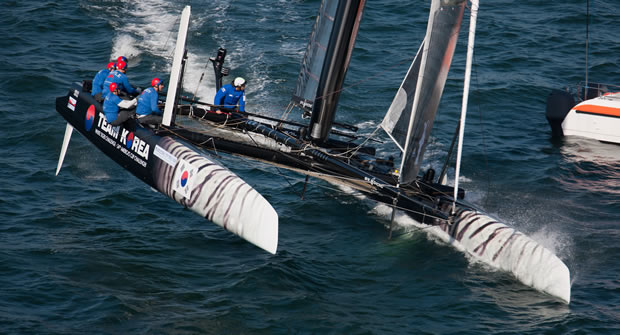
Third skipper for Team Korea
Fonte: The Daily Sail

Gilles Martin-Raget / ACEA
Peter Burling to step in as Nathan Outteridge is poached
Thursday September 20th 2012, Author: James Boyd, Location: United Kingdom
Team Korea is to have its third skipper in 12 months following the poaching of their second skipper, recently crowned 49er gold medallist, Nathan Outteridge, who is believed to be heading for Artemis Racing. This season Outteridge replaced Chris Draper who sailed the 2011 season with the fledgling Team Korea, but then went on to become one of (at least) two drivers for Luna Rossa.
New helmsman for the Korean America's Cup challenger has been announced as New Zealander Peter Burling. Burling, 21, was the Olympic silver medallist at London 2012 and he and crew Blair Tuke were training partners with Outteridge and his crew Iain Jensen. He is held to be one of the New Zealand's most talented young sailors.
Burling will take the helm of the White Tiger Challenge AC45 for the next America's Cup World Series regatta in San Francisco being held over 2-7 October, where he will become the youngest skipper in the competition by a considerable margin. This is a position he is familiar with, having been the youngest ever sailor to represent New Zealand at the Olympic Games, when he sailed in the 470 class in 2008 in China. Team Korea plans to start training in San Francisco from September 24.
Dong Young-Kim, founder of Team Korea, said: “Peter is the type of young talented newcomer who has been attracted by the high performance boats used in the America’s Cup World Series and we look forward to continuing the team’s strong performances. We are proud of what our new team has achieved in its first-ever participation in the America’s Cup.”
Another temporary change in the Korean cew will see two-time Volvo Ocean Race competitor New Zealand Andy McLean standing in for Mark Bulkeley who has a clash with own wedding to trophy wife Helen Grundy.
At present no announcement has been made over whether Team Korea will be going ahead with the build of an AC72 (and in turn will be able to challenge for the 34th America's Cup next year), although they are believed to have secured a substantial portion of their budget.
Gilles Martin-Raget / ACEA
Peter Burling to step in as Nathan Outteridge is poached
Thursday September 20th 2012, Author: James Boyd, Location: United Kingdom
Team Korea is to have its third skipper in 12 months following the poaching of their second skipper, recently crowned 49er gold medallist, Nathan Outteridge, who is believed to be heading for Artemis Racing. This season Outteridge replaced Chris Draper who sailed the 2011 season with the fledgling Team Korea, but then went on to become one of (at least) two drivers for Luna Rossa.
New helmsman for the Korean America's Cup challenger has been announced as New Zealander Peter Burling. Burling, 21, was the Olympic silver medallist at London 2012 and he and crew Blair Tuke were training partners with Outteridge and his crew Iain Jensen. He is held to be one of the New Zealand's most talented young sailors.
Burling will take the helm of the White Tiger Challenge AC45 for the next America's Cup World Series regatta in San Francisco being held over 2-7 October, where he will become the youngest skipper in the competition by a considerable margin. This is a position he is familiar with, having been the youngest ever sailor to represent New Zealand at the Olympic Games, when he sailed in the 470 class in 2008 in China. Team Korea plans to start training in San Francisco from September 24.
Dong Young-Kim, founder of Team Korea, said: “Peter is the type of young talented newcomer who has been attracted by the high performance boats used in the America’s Cup World Series and we look forward to continuing the team’s strong performances. We are proud of what our new team has achieved in its first-ever participation in the America’s Cup.”
Another temporary change in the Korean cew will see two-time Volvo Ocean Race competitor New Zealand Andy McLean standing in for Mark Bulkeley who has a clash with own wedding to trophy wife Helen Grundy.
At present no announcement has been made over whether Team Korea will be going ahead with the build of an AC72 (and in turn will be able to challenge for the 34th America's Cup next year), although they are believed to have secured a substantial portion of their budget.
quinta-feira, 23 de agosto de 2012
segunda-feira, 16 de abril de 2012
Luna Rossa thrills crowd - wins grand finale Fleet Racing Championship at the America’s Cup World Series in Naples
Fonte: AC
Chris Draper led his Luna Rossa crew to a thrilling win in the final fleet race in Naples, Italy, collecting 50 points for his efforts to vault up the leaderboard and win the AC World Series Naples Fleet Racing Championship. The victory kicked off celebrations among the tens of thousands of Italian America’s Cup fans lining the Naples waterfront to catch a glimpse of their heroes.

© ACEA 2012/ Photo Gilles Martin-Raget Download

© ACEA 2012/ Photo Gilles Martin-Raget Download

© ACEA 2012/ Photo Gilles Martin-Raget Download

© ACEA 2012/ Photo Gilles Martin-Raget Download
“We’re very pleased with the event, with the team effort,” an excited Draper said afterwards. “We didn't have huge expectations, but to come away with a first (in the fleet racing) and a second (in the match racing) is awesome."
Conditions were light, tricky and testing on Sunday, but Draper and his crew were up to the challenge. As was James Spithill and his ORACLE Racing crew, who appeared to be dead and buried in last place early in the race, only to recover and claim an impressive second place.
“The key thing was hanging in there and looking for the opportunities, and there were plenty out there,” Spithill said. “JK (tactician John Kostecki) and the guys did a very nice job… In those sorts of conditions you can go from hero to zero in a matter of seconds. We knew we just had to hang tough and wait for the opportunities. The guys found some good ways back and got us up there.”
Earlier in the afternoon, the Match Racing Championship was decided when Terry Hutchinson and his Artemis Racing team took advantage of a pre-start mistake by Chris Draper’s team to sail away with a win in the sudden-death Final. The victory was a vindication of sorts for Artemis, who had capsized in the first race of the regatta, damaging their wing and being shut out of the points on Wednesday.
“I can't say enough about the effort from the guys on the boat and on the shore,” Hutchinson said. “After Wednesday, we’d have taken today's result, that's for sure. Our team trainer says it's not how you fall down, but how you get up. Now we have to come back in a few weeks in Venice and work on our consistency.”
No records were set in this edition of the AC500 Speed Trials, as the light winds meant the fastest runs came at the end, during a brief period of stronger conditions. ORACLE Racing Bundock was able to fend off Artemis Racing by a microscopic .02 seconds to post the fastest time.
A major story in Naples has been the enthusiasm of the city as shown by the size of the crowds in the event village. Sunday was no exception, with the crowds lined deep along the waterfront to watch the action. Much of the support, unsurprisingly, was for Luna Rossa.
“We sailed along the shore after the finish and it's insane to see how many people are here,” said Luna Rossa’s Draper. “As a sailor you'd never imagine having so many people watching. It's great for the sport, and great to be part of an Italian team in front of all these people. We're very proud.”
The America’s Cup World Series now packs up and moves north to Venice, for the fifth stop on the circuit in May.
The results from Naples mean there is a new leader on the overall AC World Series Championship leaderboard. ORACLE Racing Spithill has overhauled Emirates Team New Zealand to lead by a slender one point after four events. The 2011-2012 AC World Series concludes in Newport, Rhode Island on July 1, where it appears the Championship will be decided.
Fleet Racing Championship - Standings (seven races):
1. Luna Rossa - Piranha (Helmsman: Chris Draper); 92 points
2. ORACLE Racing - Spithill (Skipper: James Spithill); 77 points
3. Emirates Team New Zealand (Skipper: Dean Barker); 60 points
4. Energy Team (Skipper: Yann Guichard); 54 points
5. Team Korea (Skipper: Nathan Outteridge); 49 points
6. Luna Rossa - Swordfish (Helmsman: Paul Campbell-James); 41 points
7. Artemis Racing (Skipper: Terry Hutchinson); 40 points
8. ORACLE Racing - Bundock (Skipper: Darren Bundock); 37 points
9. China Team (Skipper: Fred Le Peutrec); 15 points
Match Racing Championship – Sunday’s races
Final – Artemis Racing beat Luna Rossa Piranha
SF1 – Artemis Racing beat Luna Rossa Swordfish
SF2 – Luna Rossa Piranha beat ORACLE Racing Bundock
2011-12 America’s Cup World Series Provisional leaderboard
Place Team Match Points Fleet Points TOTAL POINTS
1 ORACLE Racing - Spithill 30 37 67
2 Emirates Team New Zealand 30 36 66
3 Artemis Racing 33 21 54
4 Energy Team 25 23 48
5T ORACLE Racing - Bundock 26 21 47
5T Team Korea 25 22 47
7 China Team 12 14 26
8 Green Comm Racing 11 12 23
9 Luna Rossa - Piranha 9 10 19
10 Luna Rossa - Swordfish 7 5 12
See full results here
Chris Draper led his Luna Rossa crew to a thrilling win in the final fleet race in Naples, Italy, collecting 50 points for his efforts to vault up the leaderboard and win the AC World Series Naples Fleet Racing Championship. The victory kicked off celebrations among the tens of thousands of Italian America’s Cup fans lining the Naples waterfront to catch a glimpse of their heroes.
© ACEA 2012/ Photo Gilles Martin-Raget Download
© ACEA 2012/ Photo Gilles Martin-Raget Download
© ACEA 2012/ Photo Gilles Martin-Raget Download
© ACEA 2012/ Photo Gilles Martin-Raget Download
“We’re very pleased with the event, with the team effort,” an excited Draper said afterwards. “We didn't have huge expectations, but to come away with a first (in the fleet racing) and a second (in the match racing) is awesome."
Conditions were light, tricky and testing on Sunday, but Draper and his crew were up to the challenge. As was James Spithill and his ORACLE Racing crew, who appeared to be dead and buried in last place early in the race, only to recover and claim an impressive second place.
“The key thing was hanging in there and looking for the opportunities, and there were plenty out there,” Spithill said. “JK (tactician John Kostecki) and the guys did a very nice job… In those sorts of conditions you can go from hero to zero in a matter of seconds. We knew we just had to hang tough and wait for the opportunities. The guys found some good ways back and got us up there.”
Earlier in the afternoon, the Match Racing Championship was decided when Terry Hutchinson and his Artemis Racing team took advantage of a pre-start mistake by Chris Draper’s team to sail away with a win in the sudden-death Final. The victory was a vindication of sorts for Artemis, who had capsized in the first race of the regatta, damaging their wing and being shut out of the points on Wednesday.
“I can't say enough about the effort from the guys on the boat and on the shore,” Hutchinson said. “After Wednesday, we’d have taken today's result, that's for sure. Our team trainer says it's not how you fall down, but how you get up. Now we have to come back in a few weeks in Venice and work on our consistency.”
No records were set in this edition of the AC500 Speed Trials, as the light winds meant the fastest runs came at the end, during a brief period of stronger conditions. ORACLE Racing Bundock was able to fend off Artemis Racing by a microscopic .02 seconds to post the fastest time.
A major story in Naples has been the enthusiasm of the city as shown by the size of the crowds in the event village. Sunday was no exception, with the crowds lined deep along the waterfront to watch the action. Much of the support, unsurprisingly, was for Luna Rossa.
“We sailed along the shore after the finish and it's insane to see how many people are here,” said Luna Rossa’s Draper. “As a sailor you'd never imagine having so many people watching. It's great for the sport, and great to be part of an Italian team in front of all these people. We're very proud.”
The America’s Cup World Series now packs up and moves north to Venice, for the fifth stop on the circuit in May.
The results from Naples mean there is a new leader on the overall AC World Series Championship leaderboard. ORACLE Racing Spithill has overhauled Emirates Team New Zealand to lead by a slender one point after four events. The 2011-2012 AC World Series concludes in Newport, Rhode Island on July 1, where it appears the Championship will be decided.
Fleet Racing Championship - Standings (seven races):
1. Luna Rossa - Piranha (Helmsman: Chris Draper); 92 points
2. ORACLE Racing - Spithill (Skipper: James Spithill); 77 points
3. Emirates Team New Zealand (Skipper: Dean Barker); 60 points
4. Energy Team (Skipper: Yann Guichard); 54 points
5. Team Korea (Skipper: Nathan Outteridge); 49 points
6. Luna Rossa - Swordfish (Helmsman: Paul Campbell-James); 41 points
7. Artemis Racing (Skipper: Terry Hutchinson); 40 points
8. ORACLE Racing - Bundock (Skipper: Darren Bundock); 37 points
9. China Team (Skipper: Fred Le Peutrec); 15 points
Match Racing Championship – Sunday’s races
Final – Artemis Racing beat Luna Rossa Piranha
SF1 – Artemis Racing beat Luna Rossa Swordfish
SF2 – Luna Rossa Piranha beat ORACLE Racing Bundock
2011-12 America’s Cup World Series Provisional leaderboard
Place Team Match Points Fleet Points TOTAL POINTS
1 ORACLE Racing - Spithill 30 37 67
2 Emirates Team New Zealand 30 36 66
3 Artemis Racing 33 21 54
4 Energy Team 25 23 48
5T ORACLE Racing - Bundock 26 21 47
5T Team Korea 25 22 47
7 China Team 12 14 26
8 Green Comm Racing 11 12 23
9 Luna Rossa - Piranha 9 10 19
10 Luna Rossa - Swordfish 7 5 12
See full results here
terça-feira, 20 de março de 2012


ORMA com ASA - Fotos
Alguma fotos com boa qualidade do ORMA com a ASA para o AC72, clique para aumentar
Copyrights: America's Cup


Copyrights: America's Cup


terça-feira, 6 de março de 2012
segunda-feira, 5 de março de 2012
segunda-feira, 30 de janeiro de 2012
Team New Zealand já tem asa para vento fraco
Após o seu desenvolvimento, começaram os treinos com a nova asa desenhada para vento fraco.

O team new zealand já treina com ela.

O team new zealand já treina com ela.
Subscrever:
Mensagens (Atom)